
Voice cloning is no longer a sci-fi party trick. It’s a business engine. When used responsibly and with clear consent, it opens up new ways for creators, brands, and platforms to scale their voice across markets, languages, and formats.
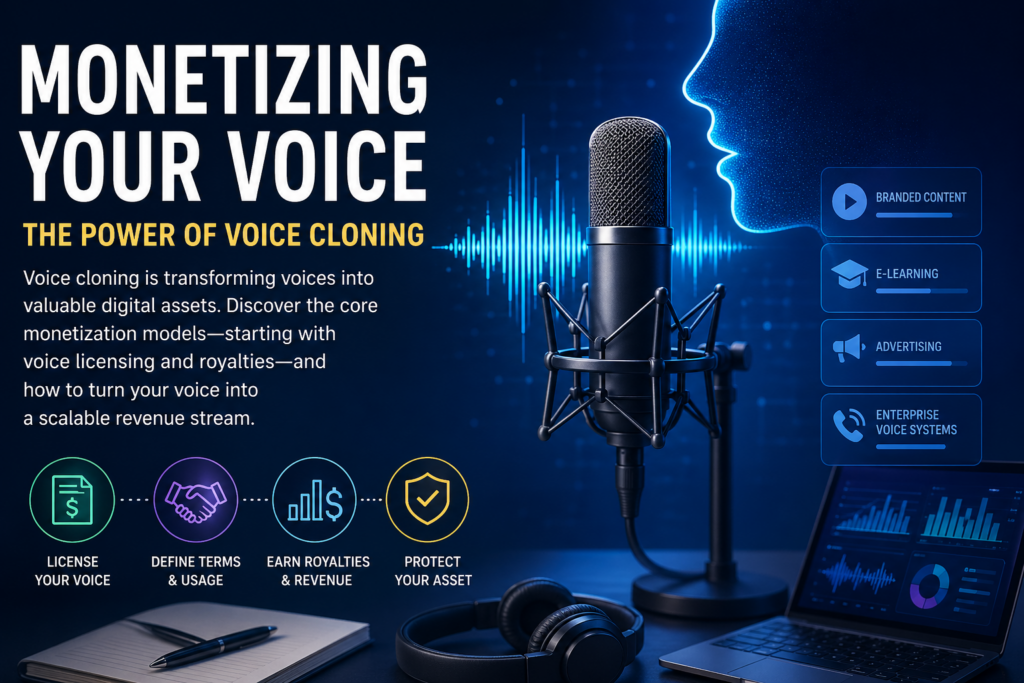
What if your voice could be in ten places at once… teaching a course, powering an ad, narrating a video, and guiding a customer through a phone system… all at the same time?
Voice cloning is turning that idea into reality.
Instead of trading time for recordings, creators and businesses can now turn a single voice into a scalable digital asset. One that speaks consistently, works around the clock, and reaches audiences far beyond what’s possible in a traditional studio.
But the real opportunity isn’t just in the technology. It’s in how that voice is monetized, licensed, and protected.
In this post, we’ll explore the core monetization models behind voice cloning, starting with one of the most powerful: voice licensing and royalties. You’ll learn how voices are packaged, priced, and deployed across industries and how the right strategy can turn a simple recording into a long-term revenue stream.
Because in this new landscape, your voice isn’t just something people hear…
it’s something that can work for you, grow with you, and earn on your behalf. 🎙️
Voice Licensing & Royalties: Going From “Income Stream” to “Voice Empire”
At this level, you’re not just licensing a voice. You’re designing a system that behaves like a tiny media company that happens to speak in your tone. Every sentence becomes inventory. Every contract becomes a pipeline.
Let’s zoom into the layers most people never build… but that separate casual earners from serious operators.
1. Revenue Architecture: Stack Your Earnings, Don’t Chase Them
Instead of choosing one pricing model, advanced setups layer multiple revenue streams on top of the same voice.
The “Stacked Deal” Example
One client engagement might include:
- Setup fee: $1,500 (voice onboarding + tuning)
- Monthly license: $400/month
- Usage fee: $0.20 per minute generated
- Performance bonus: 2% of campaign revenue
Now your voice earns:
- Upfront cash
- Recurring income
- Scalable usage revenue
- Upside from performance
That’s four income streams from one relationship.
2. Voice Packaging: Turn a Voice Into a Product Line
A single raw voice is just the beginning. The real money comes from productizing variations.
Voice Variants You Can Sell
• Tone Packs
- Warm & conversational
- High-energy sales
- Calm and instructional
- Authority / narrator
• Industry-Specific Styles
- Finance voice (clear, confident)
- Faith-based voice (steady, uplifting)
- Fitness voice (motivational, urgent)
- Corporate voice (neutral, polished)
• Language & Accent Expansion
- Spanish, French, etc.
- Regional accents
Each variation can be licensed separately or bundled at a premium.
3. Distribution Channels: Where Your Voice Actually Makes Money
Your voice needs “roads” to travel on. More roads = more revenue.
• Direct Licensing (1-to-1 Deals)
- Highest control
- Highest margins
- Slower to scale
• Platforms & Marketplaces
- AI voice marketplaces
- Freelance platforms
- Content creation tools
Tradeoff:
Less control, but faster exposure.
• API Monetization
Developers integrate your voice into:
- Apps
- SaaS tools
- Chatbots
Now your voice is earning in the background every time someone clicks “play.”
• Agency Partnerships
Marketing agencies license your voice for multiple clients.
One deal → many downstream uses.
4. Pricing Psychology: Charge Based on Value, Not Effort
The biggest mistake? Pricing based on how easy it is to generate audio.
Your client is not paying for:
- Seconds of audio
They are paying for: - Influence
- Trust
- Conversion power
Value-Based Pricing Anchors
Ask:
- How many people will hear this voice?
- Is it tied to revenue?
- Does it represent a brand identity?
Example Shift:
- Beginner thinking: “This took 5 minutes to generate”
- Advanced thinking: “This ad could generate $500,000”
Different universe of pricing.
5. Data Layer: Your Secret Weapon
The more data you collect, the smarter your pricing and negotiations become.
Track:
- Most used voice styles
- High-performing industries
- Average revenue per client
- Usage spikes by season
This lets you:
- Raise prices strategically
- Double down on profitable niches
- Predict demand
Data turns your voice from art into a measurable asset.
Conclusion: Let Your Voice Do More Than Speak
Voice cloning isn’t just a clever shortcut. It’s a shift in how value is created.
A single voice, once tied to a microphone and a schedule, can now stretch across platforms, languages, and industries. It can narrate, persuade, teach, and support, all without needing you in the room. The real magic is not the replication. It’s the repeatable revenue.
Voice licensing and royalties turn sound into structure. With the right contracts, pricing models, and safeguards, your voice becomes something you own, manage, and scale like any other digital asset.
Of course, with that power comes responsibility. Clear consent, ethical use, and strong protections are not optional. They are the foundation that keeps this opportunity sustainable and trustworthy.
As this space continues to grow, the winners will not be the loudest voices. They will be the ones who build smart systems, protect their assets, and think long-term.
So the question isn’t just “Can you clone a voice?”
It’s “Can you turn that voice into something that keeps working, earning, and expanding long after the recording stops?”
That’s where the real opportunity lives. 🎙️